
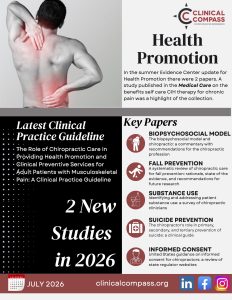
Health Promotion
In the winter Evidence Center update for Health Promotion there were 4 papers. A review published in the BMJ Open on the benefits of OMT and manual therapies for depression was a highlight of the collection.
Latest Clinical Practice Guideline
The Role of Chiropractic Care in Providing Health Promotion and Clinical Preventive Services for Adult Patients with Musculoskeletal Pain: A Clinical Practice Guideline
9 New Studies in 2025
Key Papers
BIOPSYCHOSOCIAL MODEL
The biopsychosocial model and chiropractic: a commentary with recommendations for the chiropractic profession
FALL PREVENTION
A systematic review of chiropractic care for fall prevention: rationale, state of the evidence, and recommendations for future research
SUBSTANCE USE
Identifying and addressing patient substance use: a survey of chiropractic clinicians
SUICIDE PREVENTION
The chiropractor's role in primary, secondary, and tertiary prevention of suicide: a clinical guide
INFORMED CONSENT
United States guidance on informed consent for chiropractors: A review of state regulator websites
Download PDF version
Effect of prevention strategies for lower extremity injuries in female athletes
A 2025 systematic review and meta-analysis investigated the effect of different prevention programs to reduce injury risk in sports involving running, jumping, cutting, and pivoting movements in females. 82 studies were included (48 RCTs, 16 quasiexperimental studies, 16 cohort studies and 1 cross-sectional study (total of 154,561 participants, of whom 84,915 (55%) were females. Results indicated that neuromuscular training (NMT)-based programs were most frequently studied, followed by personal protective equipment (PPE), policy/rule change and education. Point estimates from pooled results from 9 studies revealed that NMT program, which include LE balance, strength, agility and change of direction exercises, with a minimum dose of 10 min two times per week, reduced female athletes’ LE injuries by 19%. Point estimate of pooled results from 6 studies showed that NMT reduced ankle sprains by 39%. NMT significantly reduced anterior cruciate ligament (ACL) injuries by 61%. FREE FULL TEXT
Effect of myofascial release on thoracolumbar fascia in healthy young adults
A 2025 single-blind RCT examined the distant effects of myofascial release applied to the thoracolumbar fascia together with exercise training on balance, lower-extremity flexibility, and muscular endurance in 36 healthy young adults. The 3 treatment groups were: 1) myofascial release and exercise; 2) exercise only; and 3) no treatment (control). Treatment was 3x/week for 4 weeks. Myofascial release was self-applied vias foam roller; exercises addressed endurance, balance and stretching. Flexibility was assessed with sit and reach test, muscular endurance with the 1-minute sit to stand test, and balance with star excursion balance test before the intervention and at the end of the fourth week. Results indicated significant improvement in all outcomes for groups 1 and 2 but not 3. Group 1 improved significantly more than Group 2 in all outcomes. The authors concluded that the effect of distant myofascial release and exercise on flexibility, muscular endurance, and dynamic balance was greater than that of exercise alone. ABSTRACT
Effects of 12 weeks of chiropractic spinal adjustments on physiological biomarkers in adults
A 2025 parallel-group, pragmatic RCT with 106 patients aged 20-60 with subclinical spinal pain evaluated the effects of chiropractic care on physiological biomarkers, including brain-derived neurotrophic factor (BDNF), cortisol (saliva, blood, hair), inflammatory cytokines [interleukin-6 (IL-6), tumor necrosis factor-alpha (TNF-α), interferon-gamma (IFN-γ), C-reactive protein (CRP), B-lymphocytes (CD19), T-helper cells (CD4), cytotoxic T cells (CD8), and natural killer cells (CD56)]. Either spinal manipulation (SM) or sham manipulation (sham) was provided over 12 weeks and followed up at 16 weeks. Significantly higher salivary cortisol and blood BDNF levels were found in the SM group at 12 weeks.. At the 16-week follow-up, blood cortisol and TNF-α levels increased in the sham group. The authors concluded that 12 weeks of spinal manipulation modulates biomarkers linked to neuroplasticity, inflammation and stress. Increases in BDNF and interleukin-6 suggest enhanced neuroplasticity and inflammatory responses, while decreases in tumor necrosis factor-alpha indicate a regulatory effect on systemic inflammation. These findings support the notion that chiropractic care modulates physiological systemic biomarkers, which may underscore its benefits on clinical outcomes. FREE FULL TEXT
Effect of instrument-assisted C1 chiropractic manipulation (CM) on heart rate variability (HRV)
A 2025 placebo-controlled RCT assessed the effect of CM on HRV in 64 participants aged 18-60 with musculoskeletal pain. The intervention group received a single high-velocity, low-amplitude impulse on the bilateral transverse processes of C1, while the control group (CG) received a placebo. HRV was recorded both pre- and post-intervention. Results indicated that both interventions induced HRV changes without significant intergroup differences, suggesting uncontrolled factors may influence the autonomic response. The authors concluded that instrument-assisted chiropractic manipulation of C1 did not significantly change HRV vs. placebo, indicating the need for further studies on external variables. ABSTRACT
Effect of mobilization or manipulation of the thoracic spine on autonomic nervous system markers in symptomatic and asymptomatic participants
A 2025 systematic review and meta-analysis assessed the effects of thoracic mobilization/manipulation on autonomic nervous system responses. 20 studies with 863 participants were included in the analysis and 15 in the meta-analysis. 4 studies had a high risk of bias. Meta-analyses indicated no statistically significant effect of mobilization or manipulation on markers of the ANS. The ratio of low-frequency-to-high-frequency power did not significantly decrease after thoracic mobilization/manipulation compared to any type of control intervention. Skin conductance did not significantly increase after thoracic mobilization/manipulation. Subgroup and sensitivity-analyses indicated no significant effects. Due to methodological limitations and heterogeneity in reported outcomes, definitive conclusions were not possible. FREE FULL TEXT
Effect of manual osteopathic interventions on psychometric and psychophysiological indicators of anxiety, depression and stress in adults
A 2025 systematic review and meta-analysis evaluated the effect of osteopathic and related manual interventions on adult mental health (depression, anxiety, stress) and psychophysiological measures (such as heart rate variability, skin conductance). 20 RCTs were included. Osteopathic interventions reduced depression and increased skin conductance. Depression improvements were greater in pain populations. However, wide prediction intervals and moderate heterogeneity indicate uncertainty in true effect sizes, and limited studies and sample sizes restrict assessment of publication bias. The authors concluded that osteopathic and related manual therapies may reduce depression and influence certain psychophysiological markers, particularly in pain populations, but more rigorous, larger, and longitudinal RCTs are needed. FREE FULL TEXT
Effect on use of invasive pain treatment (IPT) among veterans with chronic pain of using VA Whole Health Services and integrative therapies
A 2025 longitudinal retrospective cohort study of data from 53,412 veterans with chronic pain assessed effects of use of Whole Health Services compared to non-users on downstream use of IPT. Whole Health emphasizes non-pharmacological approaches to chronic pain, including chiropractic, acupuncture, massage therapy, yoga, Tai Chi and meditation. Rates of IPT were estimated over 18 months. Results indicated that Whole Health use was associated with 42% lower utilization of IPT at 3 months but differences were minimal by 18 months (1%). The authors concluded that emphasizing non-drug approaches, such as Whole Health, may help patients interrupt patterns of escalating invasive pain management. FREE FULL TEXT
Prevention and treatment of chronic ankle instability (CAI)
A 2025 umbrella review of meta-analyses investigated the evidence for treatment and prevention of CAI. 37 studies were included. Results found strong evidence that lower weight and body mass index significantly reduce the risk of CAI. Strong evidence supports the treatment of CAI with exercise and moderate evidence supports manual therapy, acupuncture and surgery. ABSTRACT
Effect of exercise on fear of falling and number of falls in osteoporotic and osteopenia patients
A 2025 systematic review and meta-analysis investigated the effects of exercise training including balance training and aerobic training on fear of falling (FOF) and number of falls (NoF). 14 RCTs were included. There was a generally high risk of bias reported with selective reporting of results. Results of the meta-analysis indicated that exercise training reduced FOF and fall incidence in older patients with osteoporosis or osteopenia. The authors recommend inclusion of tailored exercises for fall prevention. ABSTRACT
Health Promotion, Disease Prevention and Wellness — January - June 2025 Update
Effect of mobilization or manipulation of the thoracic spine on autonomic nervous system markers in symptomatic and asymptomatic participants
A 2025 systematic review and meta-analysis assessed the effects of thoracic mobilization/manipulation on autonomic nervous system responses. 20 studies with 863 participants were included in the analysis and 15 in the meta-analysis. 4 studies had a high risk of bias. Meta-analyses indicated no statistically significant effect of mobilization or manipulation on markers of the ANS. The ratio of low-frequency-to-high-frequency power did not significantly decrease after thoracic mobilization/manipulation compared to any type of control intervention. Skin conductance did not significantly increase after thoracic mobilization/manipulation. Subgroup and sensitivity-analyses indicated no significant effects. Due to methodological limitations and heterogeneity in reported outcomes, definitive conclusions were not possible. FREE FULL TEXT
Effect of manual osteopathic interventions on psychometric and psychophysiological indicators of anxiety, depression and stress in adults
A 2025 systematic review and meta-analysis evaluated the effect of osteopathic and related manual interventions on adult mental health (depression, anxiety, stress) and psychophysiological measures (such as heart rate variability, skin conductance). 20 RCTs were included. Osteopathic interventions reduced depression and increased skin conductance. Depression improvements were greater in pain populations. However, wide prediction intervals and moderate heterogeneity indicate uncertainty in true effect sizes, and limited studies and sample sizes restrict assessment of publication bias. The authors concluded that osteopathic and related manual therapies may reduce depression and influence certain psychophysiological markers, particularly in pain populations, but more rigorous, larger, and longitudinal RCTs are needed. FREE FULL TEXT
Effect on use of invasive pain treatment (IPT) among veterans with chronic pain of using VA Whole Health Services and integrative therapies
A 2025 longitudinal retrospective cohort study of data from 53,412 veterans with chronic pain assessed effects of use of Whole Health Services compared to non-users on downstream use of IPT. Whole Health emphasizes non-pharmacological approaches to chronic pain, including chiropractic, acupuncture, massage therapy, yoga, Tai Chi and meditation. Rates of IPT were estimated over 18 months. Results indicated that Whole Health use was associated with 42% lower utilization of IPT at 3 months but differences were minimal by 18 months (1%). The authors concluded that emphasizing non-drug approaches, such as Whole Health, may help patients interrupt patterns of escalating invasive pain management. FREE FULL TEXT
Prevention and treatment of chronic ankle instability (CAI)
A 2025 umbrella review of meta-analyses investigated the evidence for treatment and prevention of CAI. 37 studies were included. Results found strong evidence that lower weight and body mass index significantly reduce the risk of CAI. Strong evidence supports the treatment of CAI with exercise and moderate evidence supports manual therapy, acupuncture and surgery. ABSTRACT
Effect of exercise on fear of falling and number of falls in osteoporotic and osteopenia patients
A 2025 systematic review and meta-analysis investigated the effects of exercise training including balance training and aerobic training on fear of falling (FOF) and number of falls (NoF). 14 RCTs were included. There was a generally high risk of bias reported with selective reporting of results. Results of the meta-analysis indicated that exercise training reduced FOF and fall incidence in older patients with osteoporosis or osteopenia. The authors recommend inclusion of tailored exercises for fall prevention. ABSTRACT
Health Promotion, Disease Prevention and Wellness—2024
Effect of neurodynamics protocol on heart rate variability (HRV) in chronic stress
A 2024 RCT with 54 participants with chronic stress investigated the effect of a neurodynamics protocol on HRV. The experimental group received treatment composed of a 6 bpm breathing protocol, manual therapy and neurodynamic technique. The control group received only the breathing protocol and manual therapy. Results indicated greater improvements in HRV variables for the experimental group during and post-intervention. The authors concluded that vagal nerve neurodynamics may be effective for enhancing parasympathetic activation in patients with chronic stress. The results highlight the importance of a more comprehensive analysis of HRV variables to obtain a correct picture of the impact of interventions on the complex and multifaceted functioning of the autonomic nervous system. FREE FULL TEXT
Immediate effects of manual therapy on respiratory functions in healthy young individuals
A 2024 RCT investigated the immediate effects of manual therapy (MT) on the respiratory functions of 104 healthy young individuals with a mean age of 20.1. Participants were randomly assigned to the MT and sham-MT groups. The experimental group underwent thoracic manipulations and mobilizations along with diaphragm mobilization. In the control group, the hands were placed in the same regions, but no specific intervention was applied. All participants underwent respiratory function testing before and after the intervention using a portable spirometer (PEF- Peak expiratory flow; FEV 1- Forced expiratory volume in 1 s; FVC- Forced vital capacity and FEV1/FVC- Tiffeneau index). Results indicated that the MT group had a significant increase in the mean PEF value following MT application. The mean PEF value in the control group showed a slight decrease. No significant changes were observed in FVC, FEV1, or FEV1/FVC values pre- and post-intervention in either group. The authors concluded that a single MT session led to a significant improvement in PEF in healthy young individuals. FREE FULL TEXT
Effect of postural exercises on postural alignment
A 2024 systematic review assessed the effect of postural exercises on postural misalignment and described the type and amount of exercise to perform to improve posture. 22 studies were included. In the analysis. The exercises that were found to be effective in improving postural dysfunction involved strengthening and stretching exercises of muscles and their antagonists. However, evidence was lacking for specific parameters for the intensity, volume, or duration of exercises, although the author pointed out the importance of these factors. ABSTRACT
Cost-effectiveness of a walking and education intervention to prevent LBP recurrence
A 2024 RCT investigated the effectiveness and cost-effectiveness of WalkBack, an individualized progressive walking and education intervention vs. no treatment to prevent the recurrence of low back pain in 701 Australian adults having recently recovered from an episode of non-specific low back pain lasting at least 24 h. The primary outcome was days to the first recurrence of an activity-limiting episode of low back pain, collected in the intention-to-treat population via monthly self-report. Cost-effectiveness was evaluated from the societal perspective and expressed as incremental cost per quality-adjusted life-year (QALY) gained. The intervention was effective in preventing an episode of activity-limiting low back pain (hazard ratio 0.72, p=0.0002). Median days to recurrence were 208 in the intervention group and 112 days in the control group. The incremental cost per QALY gained was AU$7802, giving a 94% probability that the intervention was cost-effective. Although the total number of participants experiencing at least one adverse event over 12 months was similar between groups, there were more adverse events related to the lower extremities in the intervention group. The authors concluded that this intervention was both effective and cost-effective. FREE FULL TEXT
Torticollis
Effect of non-surgical, non-pharmacological treatments for congenital muscular torticollis (CMT)
A 2025 systematic review and meta-analysis investigated the effect and safety of conservative treatment commonly used for management of CMT. 100 RCTs (80 from China) with 8,125 participants were included. Results indicated that adding manual therapy to an active control resulted in short-term improvements in passive cervical rotation (OR 9.79), passive cervical lateroflexion (OR 2.66), active cervical rotation (OR 3.94), symmetric head posture (OR 4.55), sternocleidomastoid tumor thickness and development of symmetrical movement. Adverse events were uncommon but poorly reported, with 71 (71%) of studies providing no data. Study heterogeneity limited pooling of data for meta-analysis, and there was very low to low certainty evidence for all results, due to high risk of bias, small sample sizes and study heterogeneity. The authors concluded that non-surgical, non-pharmacological treatments may be effective for CMT, but the certainty of evidence is very low to low. These findings are important in informing clinical guidelines and management for CMT. FREE FULL TEXT
Effect of exercise and manual therapy on pro- and anti-inflammatory cytokines
A 2024 narrative review investigated the effects of MT and exercise on pro- and anti-inflammatory cytokines. These cytokines have gained a significant amount of interest in their potential role in persistent pain for musculoskeletal (MSK) conditions. Chronic exercise was associated with a consistent shift towards a more anti-inflammatory cytokine profile, whereas acute bouts of intense exercise can transiently increase pro-inflammatory cytokine levels. The influence of MT on cytokines was less commonly studied and yielded more variable results. The authors concluded that the variability in findings is likely related to individual subjects and their baseline condition, the timing of measurement, and the exercise intensity, duration, and individual’s overall health and fitness. FREE FULL TEXT
Effect of spinal manipulation on the autonomic nervous system
A 2024 systematic review and meta-analysis synthesized the evidence for the possible effects of spinal manipulation (SM) on the autonomic nervous system (ANS). 14 trials involving 618 participants were included in the analysis. Low-quality evidence suggested that cervical spine manipulation may influence high-frequency heart rate variability, indicating an influence on the parasympathetic nervous system. However, when compared with control or sham interventions, SM did not alter the ANS. Due to invalid methodologies and the low quality of included studies, findings must be interpreted with caution. FREE FULL TEXT
Balance and Fall Prevention
Ankle injury prevention programs for youth sports
A 2024 systematic review and meta-analysis evaluated the exercise components of ankle injury prevention programs for high school athletes. 10 studies were included in the analysis. Results showed a statistically significant overall reduction of ankle injuries in prevention program groups vs the control groups. The authors emphasized the importance of coach and player education to optimize the frequency and duration of the programs (>30 min/wk for 6 weeks) to reduce the incidence of ankle injury. FREE FULL TEXT
Effects on balance of vibration applied to lower limbs of older adults
A 2024 systematic review assessed temporal and mechanical parameters of vibration that modulate balance to identify the short- and long-term effects of vibration on balance when applied to the lower limbs of older adults. 10 randomized controlled trials and 43 laboratory-based studies were included in the analysis. Vibration frequencies used in most studies (n=41) were ≤100 Hz. Amplitude in most studies was ≤1 mm. Short-term suprathreshold perceived muscle/tendon vibration had a large destabilizing effect size on balance in healthy older adults but little or no effect on older fallers. Short-term subthreshold vibration to the soles of the feet had a small stabilizing effect size. Suprathreshold muscle, tendon, or sole vibration applied for 10-30 min over days to weeks improved balance measures, but most (8 of 10) studies had an increased risk of bias. The authors concluded that these results suggest that the application of local vibration to the lower limbs of older adults can modulate balance in the short- and long-term. FREE FULL TEXT
Balance training for chronic ankle instability
A 2024 systematic review and meta-analysis evaluated the effect of balance training on chronic ankle instability (CAI). 9 randomized controlled trials involving 341 patients were included in the analysis. Results indicated that balance training, when compared to controls, significantly improved CAI. Balance training enhances daily activity capability, motor function, and dynamic balance, and it can be utilized to reduce the risk of a recurring sprain. However, there was no difference in outcomes when compared to strength training. FREE FULL TEXT
Health Promotion, Disease Prevention and Wellness—2023
Autonomic nervous system and endocrine system response to cervical spine mobilization in healthy male adults
A 2023 randomized crossover trial assessed the effect of upper vs lower cervical mobilization on the stress response in 20 healthy males ages 21-35. The primary outcome was salivary cortisol (sCOR). Groups received either upper then lower cervical mobilization or lower then upper cervical mobilizaition, separated by a one-week washout period. Results indicated that within groups, sCOR decreased 30 minutes after lower cervical mobilization. Between groups, sCOR concentration differed significantly at 30 minutes post-intervention (p=0.018). The authors concluded that sCOR may respond differentially to mobilizations applied to separate locations within the cervical spine. FREE FULL TEXT
Short-term effects of manual therapy on balance in healthy participants
A 2023 multi-center double-blinded RCT with 200 healthy participants (mean age=22) analyzed short-term changes in dynamic and static balance after a manual therapy (MT) protocol in healthy participants and analyzed effects on mood and perception of change. The MT protocol included spinal high-velocity, low-amplitude manipulation of the lumbar spine and lower extremity and soft tissue techniques to the lower extremity. The results suggest the MT intervention was effective on dynamic balance in post-intervention in healthy participants, and some of the directions maintained the results at the 1-week follow-up. Perception of change in post-treatment and 1-week follow-up also significantly improved. The protocol did not show changes in static balance and mood states. FREE FULL TEXT
Prevention-focused care: the potential role of chiropractors in Hong Kong’s primary healthcare transformation
A 2023 commentary discusses a rationale for including chiropractors in prevention-focused care as Hong Kong’s healthcare system moves toward a preventive and primary care focus. Chiropractic professionals are in an advantageous position to support a prevention-focused strategy by identifying musculoskeletal problems early, reducing risks, and promoting healthy lifestyles. This article examines how the involvement of chiropractors in public health programs could improve population health in Hong Kong and boost primary care. The inclusion of chiropractors in district health centers and other initiatives would offer safer and more cost-effective choices for treating functional problems and chronic pain. FREE FULL TEXT
Integrating chiropractic care into the sports industry in China and Hong Kong
A 2023 commentary explores the role of chiropractic care in the sports industry in China and Hong Kong. As a component of sports medicine, chiropractic care can enhance athletic performance, health, and competitiveness by addressing biomechanical imbalances and optimizing neuromuscular function. The potential impact of chiropractic care on the sports industry includes attracting international events and investments, leading to increased economic opportunities and the overall growth of the industry. Key strategies for promoting chiropractic care in the sports industry encompass developing a robust chiropractic care infrastructure, raising public awareness through targeted campaigns, and implementing supportive policies by governments and sports organizations. FREE FULL TEXT
The effectiveness of non-pharmacological sleep interventions for improving inpatient sleep in hospital: A systematic review and meta-analysis
A 2023 systematic review and meta-analysis investigated the effect of non-pharmacological sleep interventions for improving inpatient sleep, with the primary outcome being sleep quality. 76 studies (5375 participants) comparing 85 interventions were included. Interventions comprised physical sleep aids, relaxation, manual therapy, music, psychological therapy, light therapy, sleep protocols, milk and honey, exercise, and nursing care. The meta-analysis found medium to large improvements in sleep quality for sleep aids, relaxation, music, and manual therapies. Manual therapies showed a large improvement in sleep quality compared with controls. FREE FULL TEXT
Effect of manual therapy on HRV in people with chronic neck pain
A 2023 systematic review evaluated the immediate effect of manual therapy (MT) on heart rate variability (HRV), a measure of the autonomic nervous system, in adults with chronic neck pain. 3 RCTs were included, with a total of 112 patients. MT techniques statistically significantly improved HRV in people with chronic neck pain. The authors concluded that results support the use of MT for an acute reduction in HRV, which is consistent with decreased sympathetic tone and subjective pain. ABSTRACT
Effect of Spinal Manual Therapy on pressure pain thresholds of Patients with chronic musculoskeletal conditions and pain-free Patients
A 2023 systematic review and meta-analysis investigated the effect of spinal manual therapy (SMT) compared with sham or no intervention on local or remote (segmental or non-segmental) pressure pain thresholds (PPTs) in patients with chronic musculoskeletal conditions and pain-free patients. 22 RCTs were included. There was no significant immediate effect of SMT on local, remote (segmental), and remote (non-segmental) PPTs in patients with chronic pain or in people who were pain-free. A small but statistically significant effect was observed on remote (non-segmental) PPTs in pain-free people, but the authors did not consider it clinically meaningful. The authors concluded that no immediate, consistent, or meaningful hypoalgesic effect of SMT was shown on PPTs in various body areas. Involvement of spinal or supraspinal underlying mechanisms were, therefore, not confirmed via PPTs but should still be investigated using methods designed to assess central nervous pain processing. ABSTRACT
Health Promotion and Clinical Preventive Services: Resources for Providers and Patients
|
Topics |
Screening and/or Counseling Resources for Providers |
Information and Self-help Resources for Patients |
|
General/multiple topics |
||
|
Clinical preventive services |
|
|
|
Cultural competence |
|
|
|
Brief interventions for health behavior change |
|
|
|
Screening and Counseling—general |
|
Are You Up to Date on Your Preventive Services? (US, Medicare) |
|
Screening for low back pain |
|
|
|
Specific topics |
||
|
Alcohol misuse |
|
|
|
Blood glucose |
|
|
|
Body Mass Index (BMI) |
|
|
|
Breastfeeding |
|
|
|
Depression |
|
|
|
Diet—see Healthy Food Choices |
Diet—see Healthy Food Choices |
Diet—see Healthy Food Choices |
|
Fall prevention |
|
|
|
Healthy Food Choices |
|
|
|
Hypertension |
|
|
|
Infection control |
|
|
|
Intimate Partner Violence (IPV) |
|
|
|
Physical activity |
|
|
|
Skin Cancer |
|
|
|
Stress management |
|
|
|
Suicide prevention |
|
|
|
Tobacco |
|
|
|
Tertiary prevention of pain |
|
|
|
Unhealthy drug use |
|
|
|
Weight management |
|
|
Health Promotion, Disease Prevention and Wellness—2025 Update Effect of prevention strategies for lower extremity injuries in female athletes A 2025 systematic review and meta-analysis investigated the effect of different prevention programs to reduce injury risk in sports involving running, jumping, cutting, and pivoting movements in females. 82 studies were included (48 RCTs, 16 quasiexperimental studies,| Continue reading